What “Cash to Close” Really Means — and Why First-Time Buyers Get Surprised
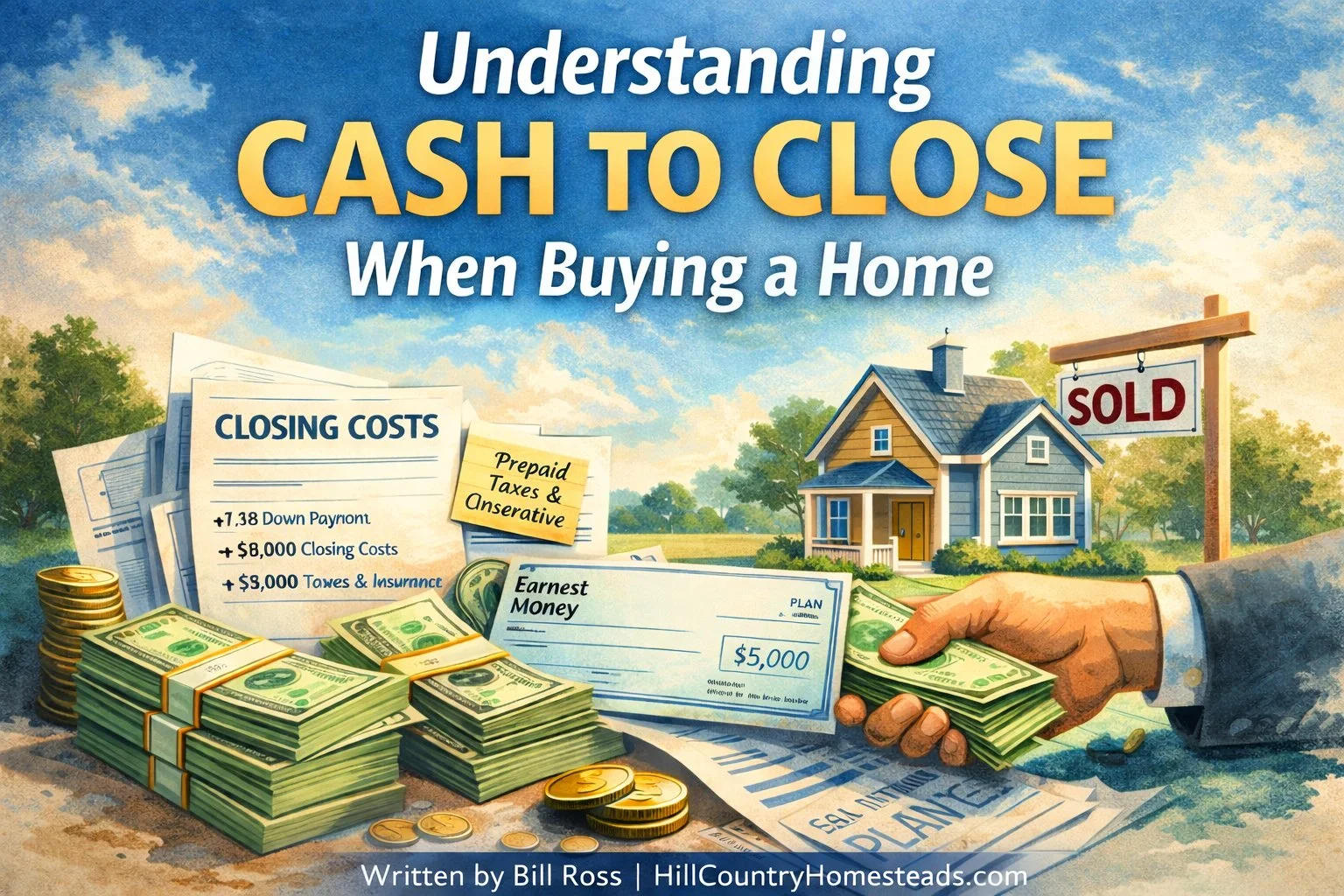
If you are buying your first home, there is one number that can either feel manageable or overwhelming: cash to close.
It is the final amount you must wire or bring in certified funds on closing day in order to receive the keys. And it is almost always higher than buyers expect.
Most first-time buyers assume that if they have saved their down payment, they are ready. Then the lender sends the preliminary closing disclosure, and suddenly the number is much larger than they had in mind. That is not because anyone is sneaking in extra charges. It is because “cash to close” includes far more than just the down payment.
Understanding it early removes stress later.
Let’s walk through it carefully.
Cash to Close Is Not Just a Down Payment
The simplest way to think about cash to close is this:
It is the total amount required to complete the transaction after accounting for:
Your down payment
All closing costs
Prepaid expenses
Escrow setup
Credits
Deposits you have already paid
Each of these pieces exists for a reason. When you understand those reasons, the number makes sense.
The Down Payment: Your Equity Stake
The down payment is the portion of the home’s purchase price you pay out of pocket. It represents your initial ownership stake in the property.
If you are buying a $450,000 home and putting 5% down, you are contributing $22,500 toward the purchase. The lender provides the rest.
This is the part buyers focus on because it is the most visible and the easiest to calculate.
What many do not realize is that the down payment is only one part of what must be brought to closing.
And depending on the loan type, the required down payment may vary:
Some conventional loans allow as little as 3% down.
FHA loans typically require 3.5%.
VA and USDA loans may require no down payment at all for qualified buyers.
But even when the down payment is low, the total cash required is not zero.
Closing Costs: The Mechanics of Making It Official
Closing costs are not arbitrary fees. They are the costs of legally transferring ownership and issuing a mortgage.
Think about what has to happen behind the scenes before you receive the keys.
A lender must:
Verify your income and assets
Evaluate your credit
Underwrite the loan
Order an appraisal
Prepare legal documentation
Fund the mortgage
A title company must:
Research the property’s ownership history
Confirm there are no liens
Issue title insurance
Coordinate escrow
Record the deed with the county
Every one of those steps involves professionals, insurance policies, legal documentation, and government filings.
That is why closing costs typically run between 2% and 5% of the purchase price.
If you purchase a $450,000 home and your closing costs total 3%, that is $13,500.
At this point, if your down payment was $22,500 and closing costs are $13,500, you are at $36,000 before we even discuss taxes or insurance.
This is where buyers begin to understand the full picture.
Prepaid Expenses: Paying Forward, Not Extra
One of the most misunderstood parts of cash to close is prepaids.
You are not being charged extra money. You are paying future obligations in advance.
For example, lenders typically require you to prepay:
Your first year of homeowners insurance
A portion of property taxes
Initial escrow reserves
If you close in Texas in October, property taxes for the year are due soon. The lender must ensure funds are available when the bill comes due. So they collect several months upfront to seed the escrow account.
If your annual property tax bill is $9,000, that is $750 per month. Depending on timing, you might need to deposit several months at closing. That could easily add several thousand dollars.
Similarly, if your homeowners insurance policy costs $2,200 annually, the first year is often paid at closing.
Again, this is not a fee. It is a prepayment.
But it increases the cash required.
Deposits and Credits: The Offsets
The number does not only move upward. It also moves downward.
When you go under contract, you typically pay earnest money. In Texas, that might be $5,000 or more. That money is not lost. It is credited toward your total cash to close.
If the seller agrees to contribute to your closing costs — perhaps $10,000 — that also reduces the amount you bring to the table.
Lenders may provide credits as well, depending on how the interest rate is structured.
Let’s put this into a realistic scenario.
You purchase a $450,000 home with 5% down.
Down payment: $22,500
Closing costs: $13,500
Prepaids and escrow setup: $7,000
Total: $43,000
You already paid $5,000 in earnest money.
The seller agrees to $8,000 in concessions.
Now the revised cash to close becomes:
$43,000 – $5,000 – $8,000 = $30,000
Still significant, but far less than the initial gross number.
This is why negotiation matters. Structure matters. Timing matters.
Why First-Time Buyers Feel Shocked
The surprise typically comes from two places.
First, buyers focus on the purchase price and monthly payment. They underestimate the upfront liquidity required.
Second, they confuse “low down payment” with “low cash needed.”
A 3% down loan sounds small — but on a $400,000 home, that is $12,000. Add $12,000 in closing costs and several thousand in prepaids, and suddenly the number approaches $25,000 or more.
It is manageable with planning. It is stressful without it.
The Bigger Mistake: Draining Every Dollar
One of the most dangerous things a first-time buyer can do is use every available dollar to close.
After closing, real life continues.
You may need:
Moving expenses
Utility deposits
Basic furniture
Minor repairs
Emergency reserves
Owning a home requires liquidity beyond the closing table.
The goal is not just to qualify and close. The goal is to close comfortably.
The Strategic Approach
The most confident buyers do three things early:
First, they get pre-approved and ask their lender for a detailed loan estimate. Not a verbal range — a written estimate.
Second, they build a buffer above that estimate. If the lender says cash to close may be around $28,000, they aim to have more.
Third, they work with an agent who understands how to structure contracts to reduce unnecessary out-of-pocket exposure.
Cash to close is not a mystery number. It is math. And math can be planned for.
Final Thought
Buying your first home is one of the most important financial decisions you will make. The monthly payment gets the attention. But liquidity wins the day.
When you understand cash to close — what it includes, why it exists, and how to manage it — you move from anxious to prepared.
Preparation changes everything.
If you want to walk through a real-world estimate based on your situation, income, and target price range, I am always happy to break it down in plain English.
Clarity builds confidence. And confident buyers make strong decisions.
FAQs
What is cash to close when buying a home?
Cash to close is the total amount of money a buyer must bring to closing. It includes the down payment, closing costs, prepaid taxes and insurance, escrow setup, minus any credits or deposits already paid.
Is cash to close the same as a down payment?
No. The down payment is only one portion of the total cash required. Closing costs and prepaid expenses are added to the down payment to determine the final amount needed.
How much should I expect to bring to closing?
Most buyers should expect between 2% and 5% of the purchase price in closing costs, plus their down payment. The exact number depends on loan type, property taxes, timing, and negotiated credits.
Can seller credits reduce cash to close?
Yes. Seller concessions, lender credits, and earnest money deposits can all reduce the total amount you must bring on closing day.