What That White Rock in Your Yard Actually Is (and Why It Matters)
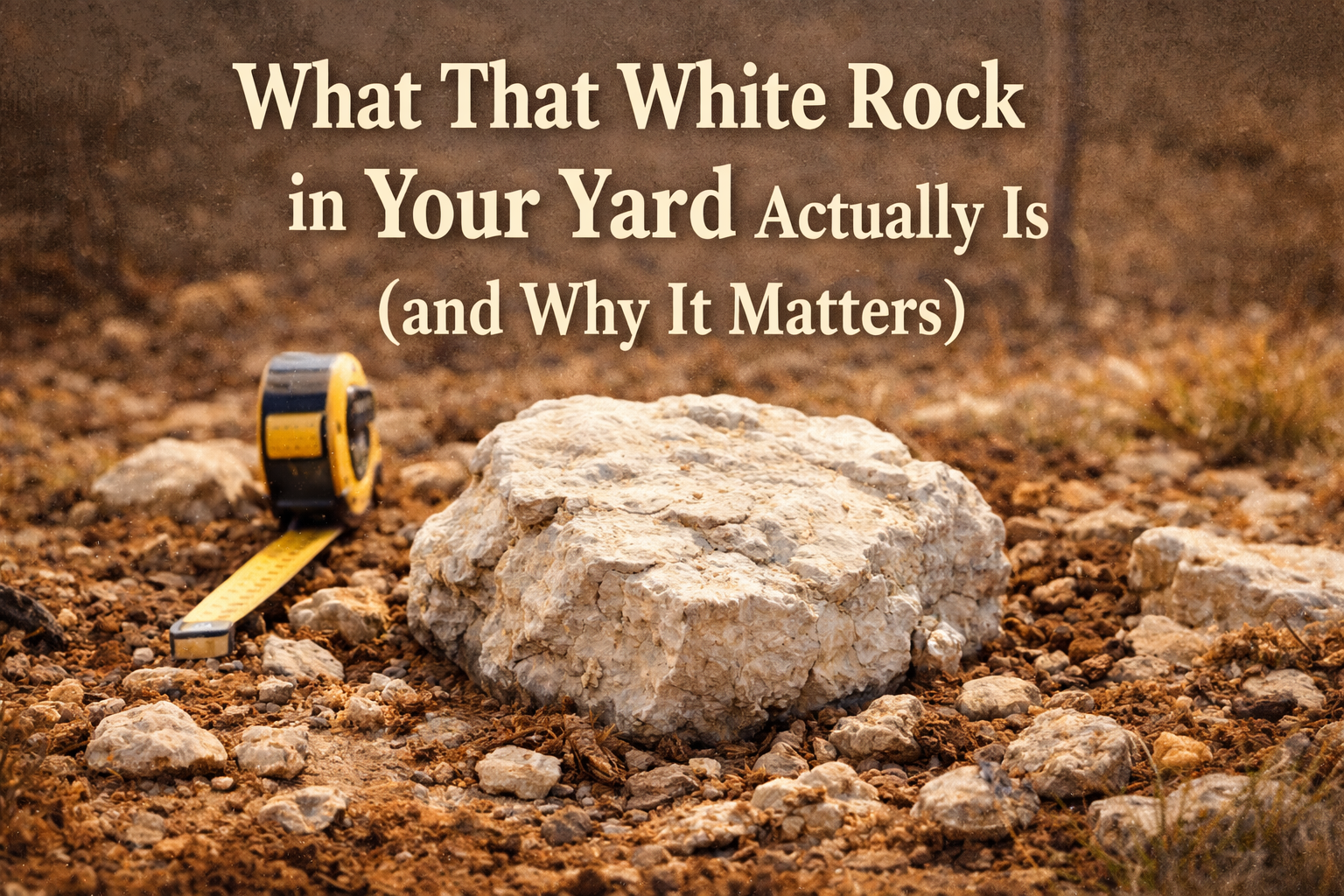
When we first moved here, I thought I understood dirt.
I’d lived in other places. I’d planted things before. I’d grown grass, dug holes, amended soil, watered faithfully, and watched things grow. So when I started seeing that chalky white “rock” peeking through the yard—at first just a few stubborn spots—I didn’t think much of it.
I figured it was gravel. Or construction debris. Or something a little extra topsoil would solve.
It wasn’t. And it wouldn’t.
That white rock was limestone. And in places, caliche. And from the moment we started planting, it quietly took control of nearly every decision we thought we were making.
The Slow Realization That the Yard Wasn’t Broken
It didn’t happen all at once. It came in small frustrations.
Water that ran off instead of soaking in.
Grass that looked fine for a month, then burned out in random patches.
Trees that stalled, struggled, or leaned as if something unseen was pushing back.
At first, I assumed I was doing something wrong. Wrong seed. Wrong timing. Wrong watering schedule. That instinct—to blame the operator—is hard to shake.
But after enough holes hit solid resistance at six inches… then four inches… then two inches, a pattern started to emerge.
The yard wasn’t misbehaving.
It was doing exactly what it had been doing for thousands—sometimes millions—of years.
Limestone vs. Caliche: Close Cousins, Different Personalities
Here’s where things get confusing, especially for newcomers.
Limestone is solid rock. Ancient seabed, compressed over geologic time, lifted, exposed, and weathered. When you hit limestone, you’re not dealing with “hard dirt.” You’re dealing with bedrock.
Caliche, on the other hand, is more like nature’s concrete. It forms when calcium carbonate binds soil particles together over time, often in arid and semi-arid climates like ours. Water moves through the soil, minerals precipitate out, and layer by layer, the ground hardens.
Both are pale. Both are stubborn. Both frustrate people who expect soil to behave like soil.
But here’s the key difference:
Limestone blocks roots and water.
Caliche repels them.
That distinction matters more than I realized at first.
Why Water Behaves So Strangely Here
One of the biggest surprises was how unpredictable water felt.
I’d water one area and watch it puddle. Ten feet away, the ground stayed bone dry. Heavy rains caused brief flooding in places that looked flat and reasonable.
The reason is limestone’s shape.
It doesn’t sit evenly beneath the soil. It forms shelves, ridges, and angled layers—almost like invisible stair steps underground. When water hits those layers, it doesn’t soak down. It slides sideways.
So instead of evenly hydrating your yard, water migrates—sometimes pooling, sometimes vanishing entirely.
Once you see it, you can’t unsee it. And suddenly, years of “mystery problems” make sense.
Why Grass Struggles (and Why It’s Not Lazy)
Grass roots want depth. They want consistency. They want cool, moist soil.
Thin soil over limestone provides none of that.
It heats up faster. It dries out quicker. And when roots hit rock, they stop. That constant stress shows up as patchy turf, especially in summer when the margin for error disappears.
You can fertilize. You can overseed. You can water religiously.
But if the root zone is only a few inches deep, you’re asking grass to run a marathon with half a lung.
The Temptation to Fight—and Why It Usually Loses
At some point, nearly everyone has the same thought:
“I’ll just break it up.”
Sometimes that works. More often, it becomes an expensive lesson.
Jackhammers, skid steers, hauling fill—these approaches add up fast, and they don’t always solve the underlying problem. You’re still working against the land instead of with it.
That was the hardest adjustment for me: letting go of the idea that the yard should behave the way I expected, and accepting that it had its own rules.
What Changed Everything: Working With the Land
Once I stopped treating limestone and caliche as enemies, things improved.
Not instantly. Not perfectly. But noticeably.
Raised beds gave plants the depth they needed.
Trees did better when placed where natural fractures already existed.
Native and well-adapted plants stopped fighting the conditions and started thriving.
And perhaps the biggest shift was mental: accepting that not every square foot wants to be turf.
That wasn’t a failure. It was information.
The Hill Country doesn’t reward force. It rewards observation, patience, and a willingness to adapt.
I’m still learning. Still misjudging holes. Still occasionally underestimating what’s beneath the surface.
But I no longer blame the yard.
It’s been honest with me from the start.