JBSA Generates More Than One-Third of Texas’ Military-Installation Economic Output
A Statewide Story Hiding in Plain Sight
Most people in San Antonio understand that Joint Base San Antonio (JBSA) is important. What is less understood is just how important it is—not just locally, but across the entire state of Texas.
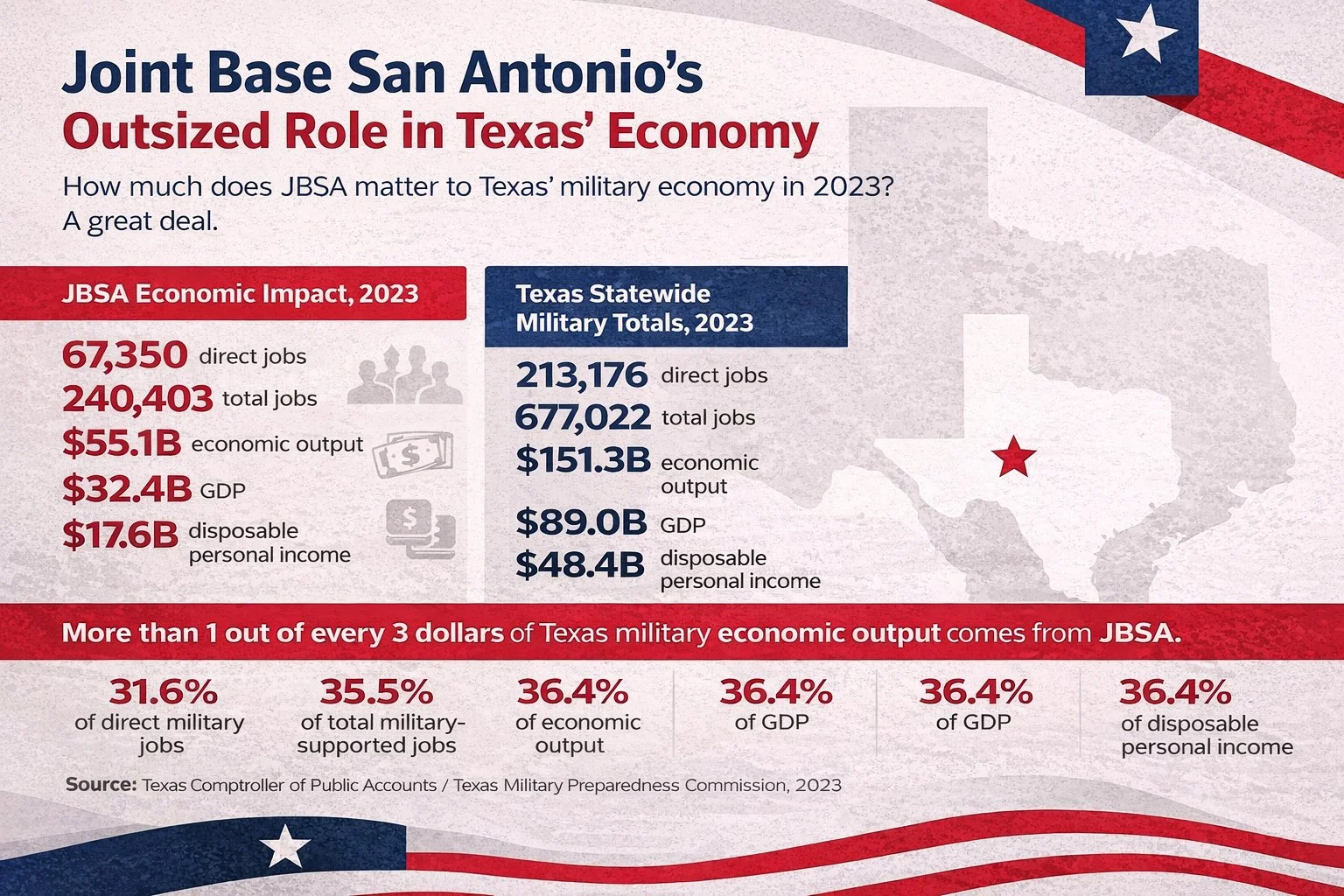
In 2023, military installations across Texas generated approximately $151.3 billion in economic output, contributed $89.0 billion to the state’s GDP, and produced $48.4 billion in disposable personal income while supporting more than 677,000 jobs.
JBSA alone accounted for $55.1 billion of that economic output.
That single number reframes the entire conversation. JBSA is not simply part of Texas’ military economy—it is one of its primary engines.
What “One-Third of the State” Really Means
When you hear that JBSA generates 36.4% of Texas’ military economic output, it is easy to gloss over the magnitude of that figure. But consider what that actually implies.
More than one out of every three dollars tied to military installations in Texas flows through JBSA. The same proportional impact holds across other measures as well—gross domestic product and disposable personal income.
This is not a statistical anomaly. It reflects a structural concentration of military activity, talent, infrastructure, and federal investment centered in the San Antonio region.
JBSA is not just large. It is disproportionately large.
Jobs, Income, and the Local Economy
The employment numbers tell a similar story, but they require a bit of interpretation to fully appreciate.
JBSA supports 67,350 direct jobs—people working on base or directly tied to its operations. When indirect and induced jobs are included—contractors, suppliers, healthcare workers, retail employees, and others supported by that activity—the total climbs to 240,403 jobs.
That distinction matters.
It means JBSA’s economic footprint extends well beyond the installation itself. It reaches into neighborhoods, school districts, medical systems, and small businesses across the region.
When JBSA grows, the local economy expands with it. When it contracts, the effects are felt far beyond the base gates.
How JBSA Stacks Up Against the Rest of Texas
The scale of JBSA becomes even clearer when compared to other major installations in Texas.
2023 Military Installations Economic Impact — Texas
| Installation | Direct Jobs | Total Jobs | Economic Output | GDP | Disposable Income |
|---|---|---|---|---|---|
| Army Futures Command | 970 | 8,757 | $1.8B | $1.1B | $1.0B |
| Corpus Christi Army Depot | 2,867 | 8,979 | $1.7B | $1.0B | $0.5B |
| Dyess AFB | 5,157 | 15,879 | $3.6B | $2.1B | $1.1B |
| Ellington Field JRB | 2,715 | 7,425 | $1.7B | $1.0B | $0.6B |
| Fort Bliss | 41,220 | 126,997 | $27.9B | $16.3B | $9.6B |
| Fort Cavazos | 59,695 | 173,730 | $39.1B | $22.9B | $10.9B |
| Goodfellow AFB | 6,220 | 12,064 | $3.1B | $1.8B | $0.8B |
| Joint Base San Antonio | 67,350 | 240,403 | $55.1B | $32.4B | $17.6B |
| Laughlin AFB | 3,043 | 7,533 | $1.7B | $1.0B | $0.4B |
| NAS Corpus Christi | 7,159 | 21,340 | $4.7B | $2.8B | $1.4B |
| NAS JRB Fort Worth | 5,041 | 22,548 | $4.9B | $2.9B | $2.2B |
| NAS Kingsville | 1,802 | 4,338 | $1.0B | $0.6B | $0.3B |
| Red River Army Depot | 3,535 | 9,228 | $1.7B | $1.0B | $0.4B |
| Sheppard AFB | 6,402 | 17,801 | $3.3B | $2.0B | $1.5B |
| STATEWIDE TOTAL | 213,176 | 677,022 | $151.3B | $89.0B | $48.4B |
Source: Texas Comptroller of Public Accounts / Texas Military Preparedness Commission, 2023. Totals may not sum due to rounding.
Fort Cavazos, the next largest installation by economic output, is a major economic driver in its own right. Yet JBSA generates roughly $16 billion more in output, along with significantly higher contributions to GDP and personal income.
More telling is what happens beyond the top tier. After JBSA, Fort Cavazos, and Fort Bliss, the remaining military installations across Texas collectively generate far less economic output than JBSA alone.
In other words, the economic weight of Texas’ military presence is not evenly distributed. It is concentrated—and that concentration sits squarely in San Antonio.
Why This Matters for San Antonio
For local residents, these numbers are not abstract. They help explain many of the economic realities of living in and around San Antonio.
Housing demand, for example, is heavily influenced by the steady flow of military personnel, civilian employees, and contractors tied to JBSA. The same is true for healthcare systems, which must support a large and stable population connected to military operations.
Education and workforce development are also shaped by JBSA’s presence. Training pipelines, technical programs, and partnerships with defense-related industries are all, in part, responses to the scale of this economic engine.
Even infrastructure decisions—from roads to utilities—are influenced by the need to support a region anchored by one of the largest military complexes in the country.
A Strategic Asset for Texas
From a statewide perspective, JBSA represents more than local economic strength. It is a strategic asset.
Texas has made significant investments over the years to retain and expand military missions, in part because the economic returns are so substantial. The concentration of activity at JBSA strengthens the state’s position in future federal decision-making, including potential base realignment or expansion initiatives.
Put simply, JBSA is not just important to San Antonio—it is important to Texas.
The Bottom Line
It is easy to think of JBSA as a local institution because it is physically located in San Antonio.
The data tells a different story.
JBSA generates more than one-third of Texas’ total military-installation economic output. It supports hundreds of thousands of jobs, drives tens of billions of dollars in economic activity, and anchors a regional economy that extends far beyond the city itself.
For San Antonio, JBSA is foundational.
For Texas, it is indispensable.
FAQ
What percentage of Texas military economic output comes from JBSA?
JBSA accounts for approximately 36.4% of total military-installation economic output in Texas.
How many jobs does JBSA support?
It supports 67,350 direct jobs and approximately 240,403 total jobs when indirect impacts are included.
Is JBSA the largest military economic driver in Texas?
Yes. It leads the state in economic output, GDP contribution, income generation, and employment impact.
Why does this matter locally?
Because JBSA directly influences housing, jobs, healthcare, infrastructure, and long-term economic stability in the San Antonio region.
Sources
https://comptroller.texas.gov/economy/economic-data/military/2023/statewide.php
https://comptroller.texas.gov/economy/economic-data/military/2023/joint-base-sa.php
https://comptroller.texas.gov/economy/economic-data/military/2023/fort-cavazos.php
https://gov.texas.gov/uploads/files/organization/military/2023-2024_Biennial_Report.pdf
https://comptroller.texas.gov/economy/economic-data/military/2023/statewide-snapshot.php