Representing Yourself in Texas Probate (“Pro Se”): Why It Usually Breaks Down When a House Is Involved
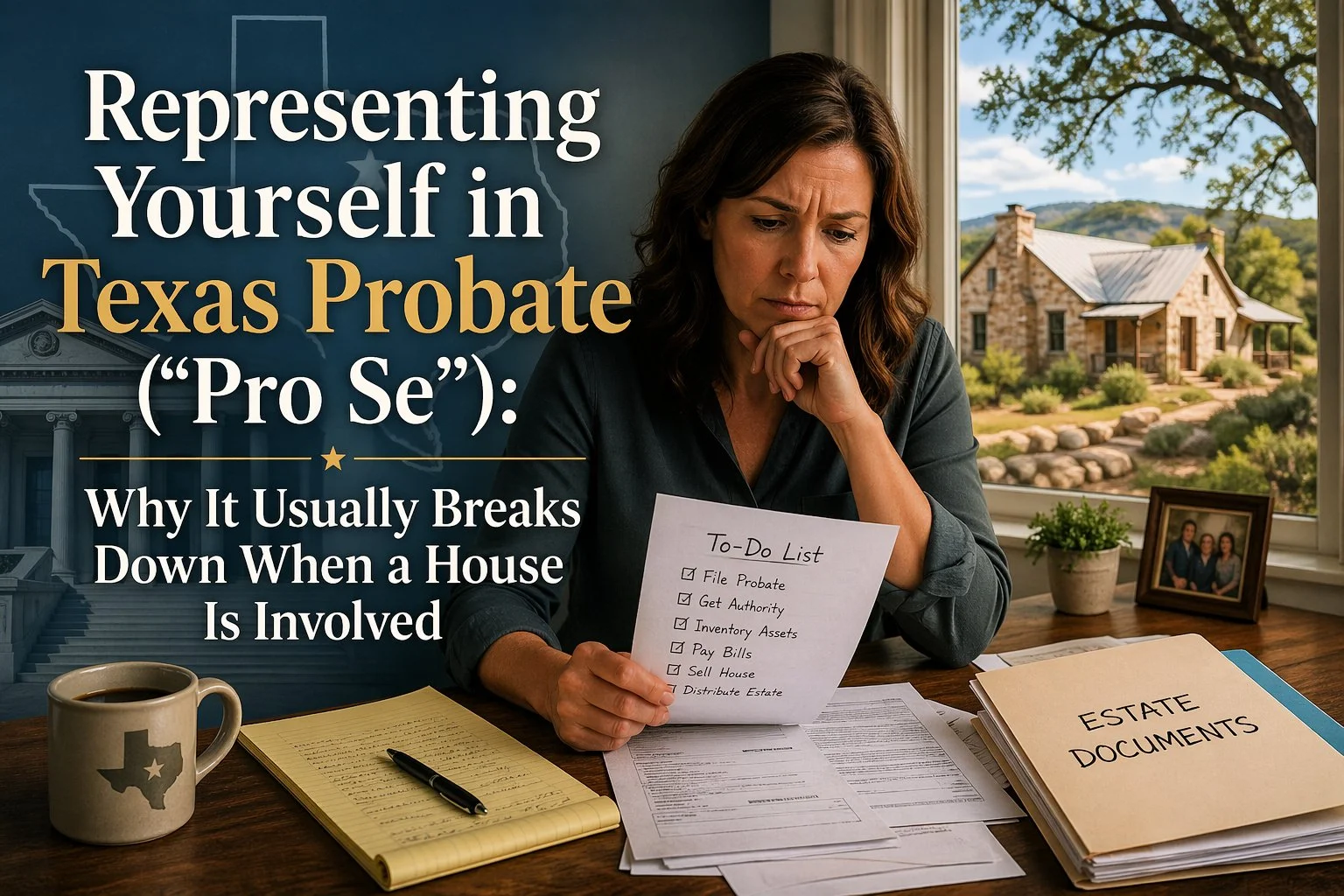
The most expensive probate mistakes often begin with a sentence that sounds perfectly reasonable:
“We’ll just handle it ourselves.”
That instinct is understandable. The funeral is over. The family is tired. The house is sitting there. Bills are still arriving. The yard still needs to be maintained. Somebody has to deal with the mail, the contents, the utilities, and eventually the sale. To a lot of families, it looks like an administrative problem, not a legal one.
That is exactly why people get into trouble.
In Texas, self-representation in probate, commonly called “pro se,” is far narrower than many people assume. Texas Law Help states that almost all probate cases require a lawyer, and it explains that probate usually begins when an attorney files the application with the court. Its self-representation guidance also makes the core point that people may represent themselves only when they are truly representing only themselves, not other interested parties.
That distinction matters even more when the estate includes a house.
A house changes the entire risk profile of probate. It creates urgency. It creates cost. It creates emotion. It creates a physical asset that deteriorates while the family is still trying to decide who has authority to do what. And it often becomes the place where grief, money, family history, legal process, and real estate reality collide.
So the issue is not whether a family is smart enough to “figure it out.” The issue is whether they understand how many ways a probate matter involving real property can go sideways.
Usually, they do not. Not at first.
Why self-representation sounds easier than it is
Most people who think about handling probate themselves are not being careless. They are trying to be responsible. They want to save money, move efficiently, and avoid wasting estate resources.
That logic sounds good until it runs into real-world probate.
One sibling assumes the will solves everything. Another assumes everyone gets along, so formalities are less important. Someone else thinks the house can simply be listed right away and the legal details can be cleaned up during the transaction. Another relative may assume that because they have access to the property, they also have decision-making authority over it.
None of that is a substitute for the correct legal path.
In probate, details that seem technical are often the details that control the outcome. Who has authority. Whether an executor has actually been appointed. Whether title can be conveyed yet. Whether there are debts. Whether the property is separate or community property. Whether all necessary people are aligned. Whether the property is vacant. Whether insurance has been reviewed. Whether the chosen probate route even matches the facts.
Those are not side issues. They are the process.
Why a house makes pro se probate much more dangerous
Probate without real estate is one thing. Probate with a house is another.
Once a home is involved, the estate no longer consists only of documents and deadlines. It includes a valuable asset that has to be secured, insured, maintained, evaluated, priced, shown, negotiated, and closed correctly. That is where many executors and heirs discover that probate is not merely a court matter. It is an operational matter too.
The house introduces at least six major pressure points.
The first is authority. Families often assume that being named in a will automatically gives someone the power to act immediately. It does not. The probate route matters. Texas Law Help explains, for example, that a muniment of title is a procedure used mainly to transfer title under a will and that in that process the judge does not appoint an executor. Instead, the will and order are recorded in the deed records to show ownership. That is very different from a full administration.
The second is fiduciary responsibility. A person acting for an estate is not just “the family member in charge.” Courts treat that person as acting on behalf of others. Harris County’s probate materials explain the point directly: where there are beneficiaries and creditors other than the applicant, the representative is not simply representing himself or herself. That is one of the main reasons courts are so cautious about pro se probate.
The third is delay. Houses do not wait patiently while families organize themselves. Vacant houses become vulnerable. Small maintenance issues become larger. Weather, leaks, pests, deferred repairs, and neglected landscaping begin to affect value. Utility decisions become complicated. Personal property remains in limbo. Every week of indecision has a cost, even when nobody has yet written a check to measure it.
The fourth is pricing. Estate homes are often mispriced for emotional reasons. Sometimes the family wants a premium because the house means something to them. Other times they want it gone quickly and are prepared to leave money on the table just to end the stress. Both are understandable reactions. Neither is a strategy.
The fifth is disclosure and condition anxiety. Many executors worry, with good reason, about what they are supposed to say about a house they may not know well. They do not know which defects matter, what prior repairs were done properly, whether an old roof issue is still relevant, or whether “as is” somehow solves all of that. It does not. “As is” changes negotiation dynamics; it does not erase legal or factual realities.
The sixth is family conflict. A probate house has an unusual ability to surface old tensions. One heir wants cash. One wants time. One wants to keep the house. One wants repairs. One thinks repairs are wasteful. One wants a relative allowed to stay temporarily. Another sees that as creating new legal and practical risk. A property can become the center of a family disagreement very quickly.
All of this is why self-representation tends to look manageable before the house becomes the focus.
Once the house becomes the focus, the weaknesses in the plan become obvious.
The exceptions are real, but they are narrow
There are limited Texas situations where a person may be able to move forward without full probate representation by counsel. But those situations are cleaner and narrower than most families think.
Texas Law Help explains that self-representation may be possible only where the person is truly representing only himself or herself. One example it gives is a valid will being probated as a muniment of title where the applicant is the sole beneficiary and there are no estate debts other than debt secured by the home, such as a mortgage or home-improvement loan. Texas Law Help also explains that small estate affidavits can sometimes be used, but only when the decedent died without a will and the statutory requirements are satisfied.
That does not describe most probate matters involving a house.
Most estate situations are messier than the exception. There may be multiple beneficiaries. There may be uncertainty over debts. There may be disagreement about whether the house should be sold, improved, rented, or retained. There may be occupancy issues. There may be out-of-state parties. There may be title issues no one knew existed. There may be personal property disputes. There may be a will, but the facts may not fit the most streamlined route.
Harris County’s probate FAQ also underscores how limited the non-lawyer route can be. It recommends attorney representation for all matters involving legal questions and notes that applicants without lawyers are generally limited to very narrow scenarios, such as muniment of title situations where all beneficiaries are co-applicants. It also notes that an out-of-state executor or administrator must designate a Texas resident agent, except in muniment proceedings.
That is a long way from “we can probably do this ourselves.”
Where self-represented executors usually get hurt
They get hurt first by confusing access with authority.
Having the keys does not mean having the power to sell. Having possession of the will does not mean the marketable title path has been established. Being the oldest child does not mean the title company, probate court, or buyer’s lender will simply accept your role because the family says you are in charge.
They get hurt next by treating the legal side and the property side as separate universes.
They are not separate. The legal path affects what can be signed, when it can be signed, who must be involved, and how title will be conveyed. The property side affects insurance, maintenance, marketing, showings, negotiations, and preservation of value. Once those two tracks are out of sync, the estate starts absorbing friction.
They also get hurt by underestimating the cost of delay.
Executors often focus on direct out-of-pocket cost and underestimate indirect loss. Vacant houses are vulnerable. Overgrown landscaping sends a signal. Deferred maintenance reduces leverage. Unresolved clean-out slows preparation. Confused family communication slows decisions. A house can lose momentum long before it ever hits the market.
And they get hurt by believing that because the family is decent, the process will remain easy.
Decent people can still disagree when they are tired, grieving, and looking at six-figure decisions. Good people can become suspicious when communication is weak. Rational people can become rigid when the house carries emotional weight. The cleaner the process, the less likely those tensions turn into damage.
The better approach
My first recommendation is straightforward: retain a qualified Texas probate attorney early.
That is not a throwaway line. It is the foundation. Texas Law Help says almost all probate cases require a lawyer, and the self-representation materials explain why the exception is the exception.
Once that foundation is in place, the family should treat the house as a managed estate asset, not as a side project.
That means confirming the legal path before anyone assumes a sale timeline. It means securing the property properly. It means reviewing insurance. It means documenting condition. It means keeping records of expenses, maintenance, access, and vendor work. It means deciding whether the property should be sold as-is, lightly prepared, or improved before sale based on evidence rather than family folklore.
It also means communicating more than feels necessary.
Silence creates suspicion in probate. Process reduces suspicion. A written plan, regular updates, documented approvals, and disciplined expectations can prevent many unnecessary disputes.
Finally, it means using professionals who understand that probate real estate is not just a normal listing with a sad story behind it. The transaction has more moving parts, more emotional land mines, and less margin for confusion.
The real takeaway
Can somebody represent himself or herself in a Texas probate matter under narrow circumstances?
Yes.
Is that usually the right strategy once a house is involved?
No. Usually not.
Not because the executor lacks good intentions. Not because the family is incapable. But because the combination of fiduciary responsibility, title path, property condition, family dynamics, timing pressure, and transaction risk is more complicated than it first appears.
That is the trap.
People think they are saving money by avoiding help early. Sometimes they are just moving the cost to a later stage, where it becomes more expensive, more stressful, and harder to unwind.
The funeral is hard.
But in many estates, the real operational pressure starts after the funeral, when somebody has to turn a house, a will, a court process, and a family into one coherent plan.
That is where improvisation usually stops working.
And that is where the right guidance starts paying for itself.
FAQ
What does “pro se” mean in Texas probate?
It means representing yourself without a lawyer. In probate, that becomes complicated quickly because the person acting for the estate is often not representing only himself or herself.
Do most probate cases in Texas require a lawyer?
Usually yes. Texas Law Help states that almost all probate cases require a lawyer.
Is there any situation where somebody might handle probate without a lawyer?
There are narrow exceptions. Texas Law Help gives examples such as certain muniment of title situations where there is a valid will, the applicant is the sole beneficiary, and estate debts are limited to debt secured by the home.
What is a muniment of title?
It is a Texas probate procedure used mainly to transfer title under a will. Texas Law Help explains that the judge does not appoint an executor in that process; instead, the will and order are recorded in the county deed records to show ownership.
Can a small estate affidavit be used when a house is involved?
Only in limited circumstances. Texas Law Help explains that small estate affidavits are available only when the decedent died without a will and the statutory requirements are satisfied.
Why does a house make probate harder?
Because real estate adds title issues, property-condition decisions, maintenance costs, occupancy questions, insurance concerns, pricing strategy, disclosure concerns, and family conflict risk.
What is the first practical step for an executor dealing with a house?
Retain a qualified Texas probate attorney, then build the property strategy around the legal path that attorney recommends.
SOURCES
https://texaslawhelp.org/article/probate-court-basics
https://texaslawhelp.org/article/probate-court-and-representing-yourself
https://texaslawhelp.org/article/handling-an-estate
https://texaslawhelp.org/toolkit/i-want-use-small-estate-affidavit-probate-estate-0
https://probate.harriscountytx.gov/Probate-Court-No-4/Frequently-Asked-Questions
https://probate.harriscountytx.gov/portals/probate/documents/pro_se.pdf