5 Texas Probate House Questions Every Executor Asks Before Selling
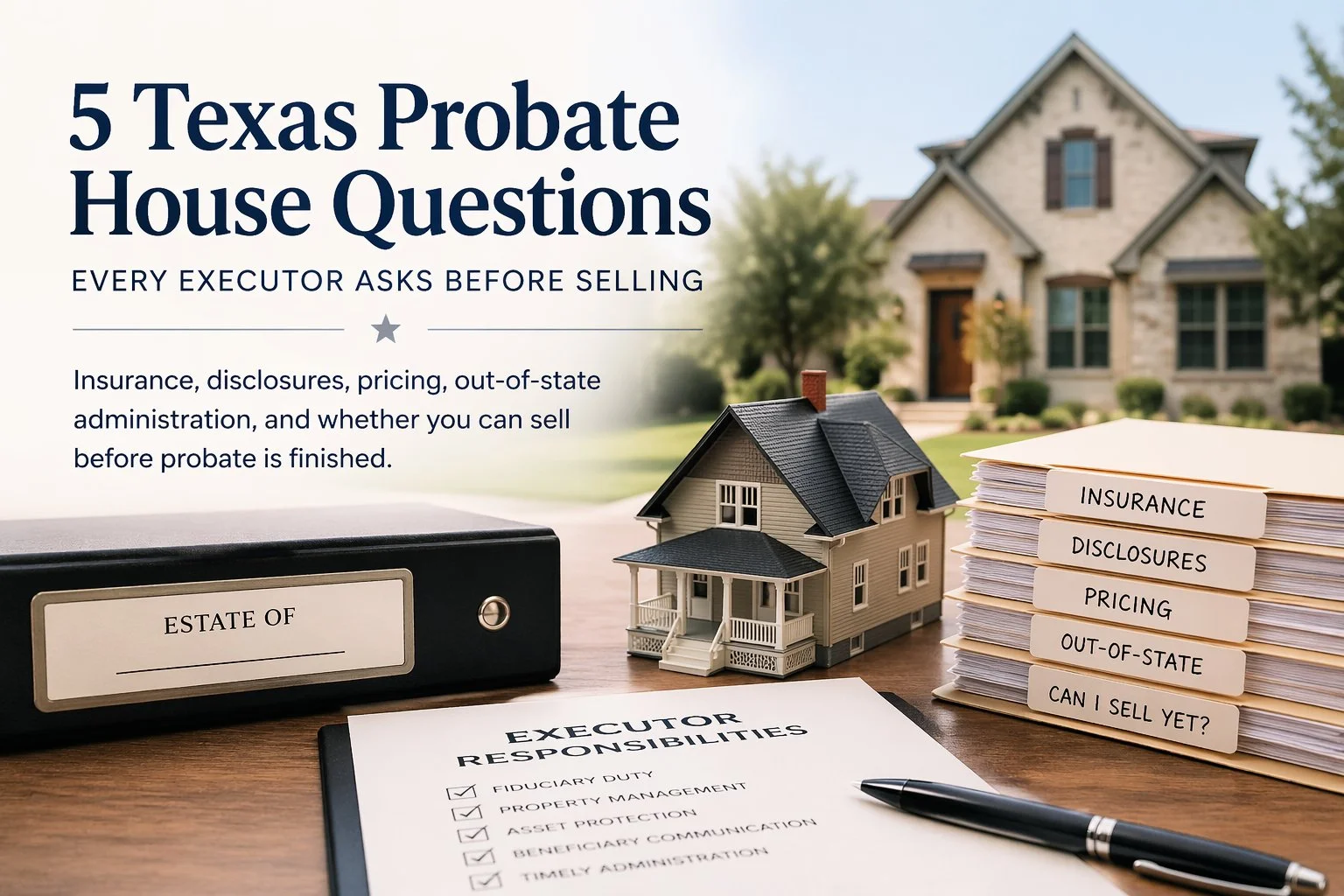
5 Texas Probate House Questions Every Executor Asks Before Selling
I got a lot of positive feedback and follow-up questions after my first post on probate. That was not surprising. Once families move past the funeral and the initial shock, the house becomes the center of gravity. It is sitting there. Bills are still coming in. Insurance may have changed. Relatives have opinions. And the executor is the one expected to make sense of it.
That is where the stress usually spikes.
Most executors are not afraid of doing hard things. What rattles them is the feeling that one wrong move could cost the estate money, create family conflict, or expose them to blame later. In my experience, the most common questions are not abstract legal questions. They are practical, urgent, and expensive if handled poorly.
Here are five of the biggest ones.
1) “The house is empty. Isn’t the existing insurance good enough?”
Sometimes yes. Sometimes absolutely not.
This is one of the fastest ways an estate can get hurt. Many people assume the homeowner’s policy simply stays in place until the house sells. That assumption can be costly. Once a property becomes vacant or effectively unoccupied for too long, coverage can narrow, exclusions can kick in, or the carrier may require a vacancy permit or different policy structure altogether.
That matters because vacant houses do not just sit quietly. Pipes leak. HVAC systems fail. Thieves notice. Vandals notice. Storm damage gets worse when nobody is there to see it early. A small issue that would have been minor in an occupied home can become a major claim in a vacant one.
The practical problem for executors is that they are often dealing with grief, paperwork, and family logistics while the insurance clock is already running. By the time someone asks whether the policy still works the way they think it does, the risk window may already be open.
The safer approach is simple: treat vacancy as a decision point, not a footnote.
As soon as it becomes clear the home may sit empty, the executor should contact the carrier or agent, explain the death and occupancy status, and ask for the answer in writing. Not a casual verbal reassurance. In writing. The estate needs to know whether the current policy remains in force, whether there is a vacancy deadline, whether theft or water damage limitations apply, and whether the carrier expects inspections, temperature control, lawn maintenance, or regular property checks.
This is also where “helpful” family solutions can create new problems. Letting a relative move in temporarily, leaving utilities disconnected, or delaying basic maintenance may sound harmless in the moment, but each of those choices can affect risk, coverage, and marketability.
The real issue is not just insurance. It is control. If the estate loses control of the property, everything downstream becomes harder. That includes repairs, pricing, negotiations, and closing.
2) “I never lived there. How can I possibly make disclosures?”
This is the question that causes more anxiety than almost any other.
Executors worry about being asked to certify facts they do not know. They are afraid of either saying too much or not saying enough. And frankly, they should take the issue seriously.
In Texas, seller disclosure is governed by law, but the everyday problem is more nuanced than many people realize. Some estate-related sellers may be exempt from the standard seller’s disclosure notice. That does not mean they are free to play dumb, hide known defects, or let obvious facts stay buried. “I never lived there” is not a strategy. It is, at best, one fact in a much bigger risk-management conversation.
This is where executors usually get themselves in trouble. Not through elaborate fraud. Through casual assumptions.
They say things like:
“I have no idea whether the foundation was repaired.”
“I think the roof leak was fixed.”
“My brother handled all that.”
“The buyer can inspect it anyway.”
That is not good enough if the estate actually has information available.
If the family knows there were prior plumbing problems, foundation work, roof leaks, fire damage, cast-iron drain issues, prior insurance claims, flood history, or recurring HVAC trouble, the right response is not to hope the buyer never asks the right question. The right response is to collect the information, organize it, and decide how to present it clearly and consistently.
This is one of the places where a trusted advisor matters. The executor does not need to know everything. But the executor does need a process for determining what is known, what is unknown, what can be documented, and what needs to be addressed before the home is marketed.
A practical way to think about it is this: buyers can handle bad news far better than surprise. Surprise kills deals. Surprise invites legal headaches. Surprise makes people wonder what else was not said.
The estate is usually better served by a clean, disciplined disclosure strategy than by ambiguity.
3) “How do I price an inherited house when emotions are all over the place?”
This is not just a pricing issue. It is a fiduciary issue.
The house may be full of memories. One sibling may think it is worth far more than the market will pay because “Mom kept it nice.” Another may want it sold immediately at a discount just to end the ordeal. Both instincts are understandable. Neither is reliable.
Executors get squeezed from both sides. Price it too high and the listing sits, the house ages further, carrying costs continue, and the family starts questioning your judgment. Price it too low and someone may later argue that you gave away estate value.
The answer is not to guess. The answer is to separate sentimental value from market value.
A serious pricing strategy for an inherited home should account for condition, deferred maintenance, clean-out status, likely buyer profile, financing limitations, neighborhood demand, days on market, and what the property would need to compete with fully updated homes nearby. It should also account for the sale strategy itself.
Is this truly an as-is sale?
Is the estate willing to do basic prep?
Would a light renovation materially widen the buyer pool?
Is the house financeable in its current state?
Would an appraisal help calm beneficiary disagreement?
Is the best buyer a retail buyer, a cash buyer, or an investor?
These are not cosmetic questions. They determine the actual value path.
One of the biggest mistakes executors make is anchoring to a county appraisal value, an old refinance appraisal, or what a neighbor says their house sold for. None of those is a pricing plan. A pricing plan has to be tied to current, relevant, condition-adjusted comparables and to the estate’s tolerance for time, repairs, and risk.
This is where a lot of estates quietly lose money. Not because no one cared, but because no one slowed down long enough to distinguish between what the home meant and what the market will pay.
4) “I live out of state. Can I still handle this?”
Yes, sometimes. Easily, no.
Texas does allow a nonresident personal representative in certain circumstances, but distance creates a completely different layer of execution risk. It is one thing to have legal authority. It is another thing to manage a vacant Texas house from hundreds or thousands of miles away.
Out-of-state executors often underestimate the operational drag:
mail retrieval,
utility changes,
insurance coordination,
lock changes,
lawn care,
pool care,
clean-out,
contractor access,
photography,
inspections,
repairs,
title requests,
document signing,
and the basic need for someone local to verify what is actually happening at the property.
Distance also magnifies family noise. When the executor is not local, every cousin, neighbor, and sibling suddenly becomes a field reporter. Some of what they say is helpful. Some of it is inaccurate. All of it can become distracting. The executor starts making decisions based on fragments instead of a controlled plan.
That is why out-of-state administration works best when the executor builds a local team early. Not a random collection of vendors. A coordinated bench: probate counsel, title company, insurance contact, trustworthy local property support, and a real estate professional who understands that probate sales are not ordinary listings.
The executor’s job is not to do every task personally. The executor’s job is to create order, document decisions, and keep the estate moving with as few preventable surprises as possible.
Distance does not make that impossible. It just makes amateur improvisation far more dangerous.
5) “Can I sell the house before probate is finished?”
This is the question people usually ask too late.
The honest answer is: sometimes, but not always, and the phrase “before probate is finished” hides several different issues.
In Texas, the critical question is not whether someone has filed something with the court. The critical question is whether the person signing the contract and closing documents actually has the authority to sell, and whether the title company is satisfied that title can be conveyed.
That depends on the path the estate is on.
If there is an independent administration, the executor may have broad authority to act with much less court supervision. If it is a dependent administration, court involvement can be heavier and sale approval may be required. In other situations, the property may pass outside full administration altogether because of survivorship rights, a trust, or a transfer-on-death deed. And small-estate shortcuts are far narrower than many people assume.
This is where people get burned by bad simplifications.
“I have the will” is not the same as “I can close.”
“We filed probate” is not the same as “title is ready.”
“The family agrees” is not the same as “the estate has authority.”
“There’s a small estate affidavit” is not the same as “this house can be sold normally.”
Texas does provide simplified options in some cases, but they are limited. A small estate affidavit is not a universal workaround for selling inherited real estate. In general, it applies only in narrower situations and is not the clean shortcut many families imagine.
The practical takeaway is this: do not promise a buyer a closing timeline until the authority question has been checked from three angles at once:
the probate posture,
the actual signing authority,
and the title company’s requirements.
That one discipline will prevent a remarkable amount of confusion, embarrassment, and wasted motion.
The bigger lesson
Executors usually do not get hurt by one dramatic mistake. They get hurt by ordinary assumptions made under pressure.
They assume the insurance is fine.
They assume “as-is” solves disclosure.
They assume the market will forgive sentimental pricing.
They assume distance is just an inconvenience.
They assume filing probate means they are ready to sell.
That is where estates lose time, money, and leverage.
The good news is that these problems are manageable when addressed in the right order. The right plan usually starts with authority, insurance, property condition, and pricing strategy. Only after those pieces are aligned should the estate decide how aggressively to market the home and how fast it should move.
If you are serving as an executor, the goal is not just to get the house sold. The goal is to get it sold in a way that protects the estate, reduces avoidable conflict, and holds up under scrutiny later.
That takes more than good intentions. It takes a process.
This article is for general informational purposes only and is not legal advice. Executors should get Texas probate guidance for their specific facts before relying on any general discussion of estate administration or sale authority.
FAQ
Does an executor have to complete a seller’s disclosure notice in Texas?
Not always. Texas law provides exemptions in some fiduciary sale situations, but exemption from the standard form is not the same thing as permission to conceal known material problems. Executors should still be careful about what is known, documented, and communicated.
Can a vacant inherited house lose insurance coverage?
Yes. Vacancy or prolonged non-occupancy can trigger policy limitations, exclusions, or a need for different coverage. The executor should confirm coverage terms with the carrier in writing as soon as the home is expected to sit empty.
Can an out-of-state executor handle a Texas house sale?
Potentially, yes. But legal eligibility is only part of the issue. Long-distance administration creates practical problems with security, maintenance, contractors, title work, and local oversight.
Can an executor sell a Texas house before probate is fully closed?
Sometimes. The real issue is authority and title, not just whether probate has been filed. The answer depends on the estate structure, court posture, and what the title company will accept.
Is a small estate affidavit an easy way to sell inherited real estate in Texas?
Usually not. It is a narrow tool and not a general shortcut for selling a typical inherited house. Families often overestimate what it can do.
What is the biggest mistake executors make with inherited homes?
Assuming the house can just be treated like an ordinary home sale. Probate sales involve authority, insurance, disclosure, family dynamics, and timing issues that need to be handled in the right sequence.
Sources
[1] Texas vacancy insurance / consumer guidance
https://insuranceindustryblog.iii.org/when-no-ones-home-understanding-roleof-vacancy-insurance/
[2] Texas seller disclosure law and estate-sale guidance
https://statutes.capitol.texas.gov/Docs/PR/htm/PR.5.htm#5.008
https://altituderealestatetx.com/blog/seller-disclosures-for-estate-sales-in-texas/
[3] Texas independent administration / power to sell
https://statutes.capitol.texas.gov/Docs/ES/htm/ES.401.htm#401.001
https://statutes.capitol.texas.gov/Docs/ES/htm/ES.402.htm#402.001
https://statutes.capitol.texas.gov/Docs/ES/htm/ES.402.htm#402.052
[4] Nonresident personal representative
https://statutes.capitol.texas.gov/Docs/ES/htm/ES.304.htm#304.003
https://texaslawhelp.org/article/handling-an-estate
[5] Dependent administration / court approval for sale
https://statutes.capitol.texas.gov/Docs/ES/htm/ES.356.htm#356.251
[6] Small estate affidavit limits in Texas
https://texaslawhelp.org/article/transferring-the-deceaseds-property-without-going-to-court
https://texaslawhelp.org/toolkit/i-want-use-small-estate-affidavit-probate-estate-0