Why America Still Chooses Texas: What the 2025 Migration Map Really Tells Us
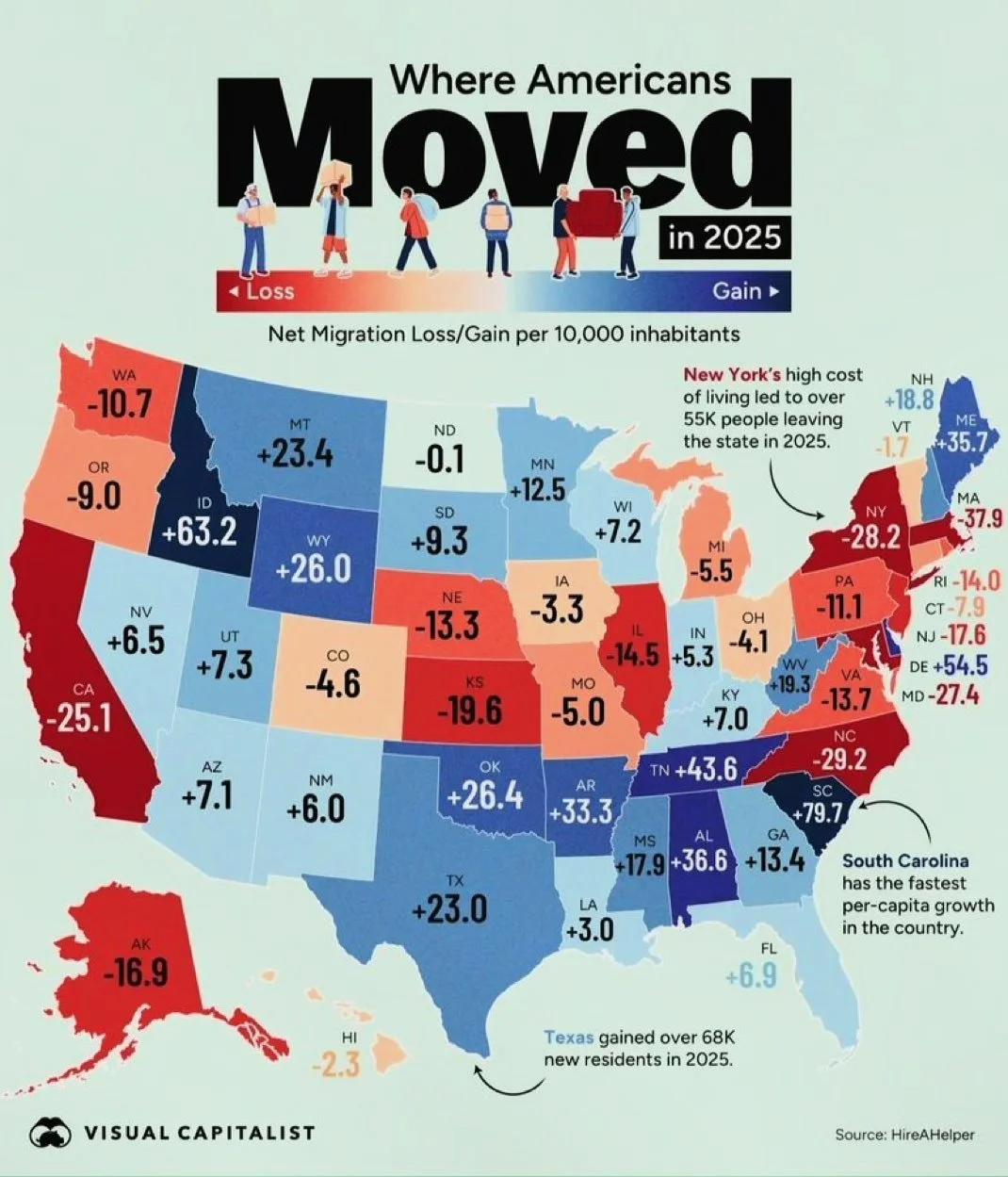
A Map That Says More Than It First Appears
Every so often an image comes along that captures, in a single frame, what millions of Americans are already feeling in their daily lives. The 2025 migration map is one of those images.
At first glance, the message seems straightforward. Many of the country’s highest-cost and most politically dominant coastal states are losing residents, while much of the South and parts of the Mountain West are gaining them. Texas is firmly on the winning side of that pattern. That is not a minor observation. It is a reflection of something deeper happening in the country: Americans are increasingly making practical decisions about where they can build a stable, affordable, and workable life.
But the map is also worth reading carefully. It shows net migration gain or loss per 10,000 inhabitants, not total population growth. That distinction matters. A smaller state can look spectacular on a per-capita basis, while a very large state can post enormous raw gains without appearing to dominate the graphic. That is exactly what happens with Texas. HireAHelper’s 2026 migration report shows Texas with the largest net gain in total residents in 2025, even though states such as South Carolina look more dramatic on a per-capita basis.
There is also a caution flag. The map is useful, but it is not flawless. One obvious issue is North Carolina. The image shows North Carolina as a significant loser, yet HireAHelper’s own report lists North Carolina among the top gain states, and Census-based analyses likewise show North Carolina as one of the strongest gainers in domestic migration. So the image should be treated as directional rather than perfect. Even so, its larger message holds up: Americans are continuing to shift toward states that offer more room to breathe financially and socially, and Texas remains one of the clearest beneficiaries of that movement.
The Real Story Is Not Politics Alone. It Is Practicality.
A lot of commentary about interstate migration quickly turns into partisan theater. That misses the point.
Most families do not wake up one morning and say they are moving because of ideology alone. They move because something in their current state has stopped working for them. The mortgage is too high. The rent keeps climbing. Taxes feel punitive. Streets feel less safe. Homeless encampments spread. Schools become a concern. Starting or growing a business feels harder. A paycheck that once supported a decent life now barely covers the basics.
That is where migration becomes a practical referendum. It is not usually one issue. It is the cumulative effect of many issues, all pressing at once. And when people begin asking where in America they can still buy a home, keep more of what they earn, raise a family, and plan for the future without feeling squeezed from every angle, Texas ends up on the shortlist very quickly.
Why High-Cost States Keep Losing People
The losing states on the map are not random. California, New York, Illinois, New Jersey, Washington, and Massachusetts all show up in this conversation again and again for a reason. They combine some mix of high taxes, expensive housing, elevated regulation, visible public disorder, and a growing sense among residents that ordinary middle-class life is becoming harder to sustain.
This is where cost of living becomes decisive. According to the Bureau of Economic Analysis, Texas had an overall regional price parity of 97.1 in 2024, slightly below the national average. California was at 110.7, one of the highest in the country. Housing is where the gap becomes brutal: California had the nation’s highest housing-rent parity at 154.3. In plain English, that means daily life in California, and especially housing, costs substantially more than it does in Texas. That is not an abstract statistic. It shapes whether families can buy a home, save money, absorb unexpected expenses, or live in a neighborhood they actually want to live in.
This is why the map matters. It is not just about who moved. It is about why so many people are deciding that staying where they are no longer makes economic sense.
Taxes Still Matter More Than Politicians Like to Admit
Taxes are not the only reason people move, but anyone claiming they do not matter is not being serious.
Texas has no state individual income tax. By contrast, states such as California and New York impose some of the highest state income tax rates in the country, with top rates of 13.3% and 10.9%, respectively. That difference matters to high earners, but it also matters to upper-middle-income families, small business owners, independent contractors, retirees drawing investment income, and anyone trying to preserve more of what they have spent decades building.
Critics will correctly point out that Texas relies more heavily on property taxes than some other states. Fair enough. That is a legitimate consideration. But for many movers, especially those coming from high-tax, high-cost states, the overall equation still looks much better in Texas. People are not comparing one tax line item in isolation. They are comparing the full burden of living.
And that full burden often looks lighter in Texas.
Jobs and Opportunity Still Drive Real Decisions
Affordability without opportunity is not a winning formula. A cheap place with weak job prospects is not a magnet for ambitious families. Texas keeps attracting people because it is not merely more affordable. It is also economically relevant.
The Bureau of Labor Statistics reported Texas at a 4.3% unemployment rate in December 2025. That was better than California at 5.5%, New Jersey at 5.4%, Washington at 4.7%, Massachusetts at 4.8%, and New York at 4.6%. That does not mean Texas is perfect or that every labor market inside the state is equally strong. It does mean Texas continues to offer a broad, diversified economy that compares favorably with many of the states losing residents.
That matters because migration is not just a housing story. It is a confidence story. People move when they believe they can land on their feet, find work, grow a business, or reposition their family for a better future. Texas still projects that kind of confidence.
The same pattern shows up in relocation data. Texas REALTORS, using U.S. Census American Community Survey data, reported that 7.8% of all state-to-state moves in 2024 went to Texas, second only to Florida. Texas also had the highest number of people moving within the state, at 3.414 million. That suggests something important: Texas is not just attracting outsiders. It is large, dynamic, and economically active enough that people are also reshuffling within Texas in very large numbers as they chase jobs, housing, and lifestyle improvements.
Crime, Homelessness, and the Meaning of Public Order
This is the part of the conversation many people want either exaggerated or ignored. Neither approach is useful.
Nationally, the FBI reported that violent crime fell 4.5% in 2024 and property crime also declined. That is good news, and it means the broader crime picture is not as simple as cable news rhetoric often suggests.
But migration is not driven by national averages. It is driven by lived experience. Families do not move because they read one national crime report. They move because they no longer like what they see around them. They notice disorder. They notice open drug use, retail theft, deteriorating public spaces, aggressive street conditions, or the expansion of homelessness in commercial and residential areas. Whether every perception is statistically perfect is almost beside the point. When enough people conclude that public leadership is not maintaining order, trust begins to erode.
Homelessness is especially important because it is both a humanitarian crisis and a visible marker of strain. HUD’s 2024 Annual Homelessness Assessment Report shows that the national rate was 23 people experiencing homelessness per 10,000 residents. California stood at 48 per 10,000, and New York was even higher at 81 per 10,000. Those are not small differences. They reflect deep housing and governance pressures in the very states that many residents are leaving.
Texas has homelessness challenges too, especially in its major urban centers. No honest observer should pretend otherwise. But Texas has not allowed that issue to define the statewide brand in the way it has in parts of California, New York, Oregon, or Washington. For many households considering a move, that matters.
Politics Matters Most When It Becomes Daily Life
People often say they are leaving for affordability, opportunity, or quality of life. What they do not always say out loud is that politics shapes all three.
Politics determines whether a state rewards production or punishes it. Politics affects housing supply, zoning, permitting, policing priorities, energy policy, business climate, school systems, and the general balance between regulation and freedom. So while movers may not describe their decision in ideological language, policy is often sitting underneath the decision whether they acknowledge it directly or not.
This is one reason Texas remains attractive. The state still carries a reputation, and in many respects a reality, of being pro-growth, pro-business, and less hostile to aspiration than many of its competitors. That reputation may irritate people who dislike Texas politically, but it has been a powerful draw for families, entrepreneurs, and professionals who feel overmanaged in other places.
The migration numbers do not prove that every person moving to Texas is making an ideological statement. They do show that a great many Americans are gravitating toward states where the rules feel more workable and the future feels less constrained.
Why Texas Keeps Standing Out
Texas is not winning because it is perfect. It is winning because, for millions of Americans, it still looks functional.
It offers scale. It offers economic diversity. It offers no state income tax. It offers a cost structure that remains more manageable than the big coastal states. It offers more attainable housing than many of the places people are leaving behind. And just as important, it offers a psychological sense of possibility. That matters more than many analysts admit.
The Census Bureau’s latest population release shows Texas with strong gains from both domestic and international migration between mid-2024 and mid-2025. HireAHelper’s migration report likewise places Texas at the top for net resident gains in 2025. Texas REALTORS’ relocation report adds another layer, showing that Texas continues to attract a very large share of interstate movers. These are different datasets measuring slightly different things, but they point in the same direction. Texas remains one of the most attractive destinations in America for people looking to improve the terms of their lives.
That should not surprise anyone paying attention. Americans are not fools. When enough people leave the same types of states and head toward the same types of destinations, they are telling us something. They are telling us that affordability matters. Work matters. Public order matters. Tax policy matters. Governance matters.
And they are telling us, very clearly, that Texas still makes sense.
The Bottom Line
The 2025 migration map is not flawless, but its underlying message is hard to miss. Americans are moving away from places where the cost of living, tax burden, public disorder, and political management have made ordinary life harder, and they are moving toward places that still offer room to advance.
Texas is not merely benefiting from that trend. It is one of the central reasons the trend exists.
For people looking for more house, more breathing room, more financial sanity, and a better shot at long-term stability, Texas continues to make one of the strongest cases in the country.